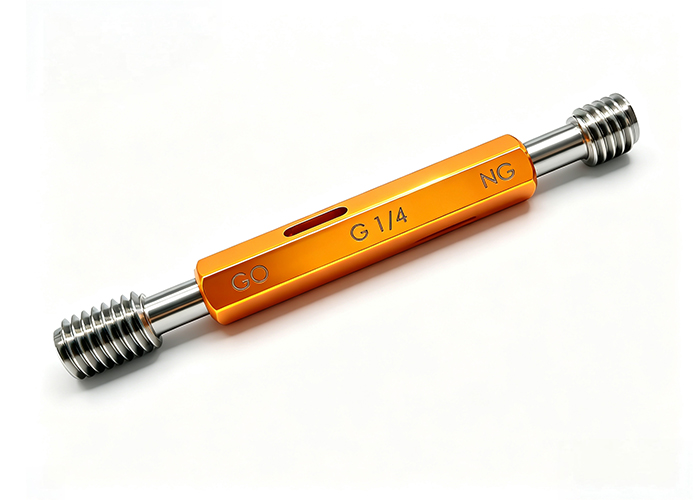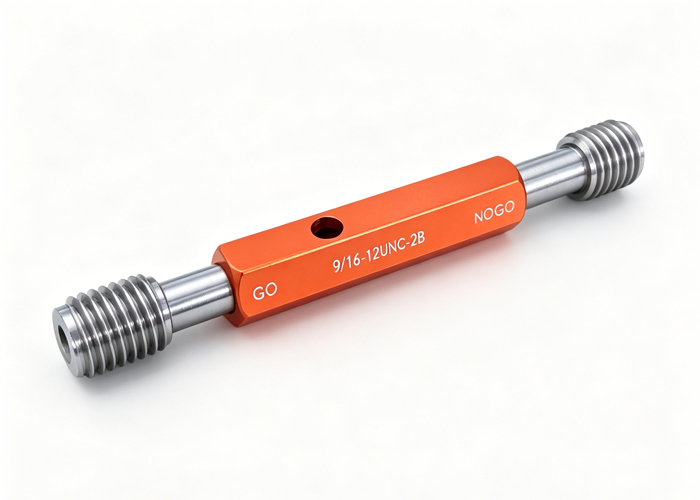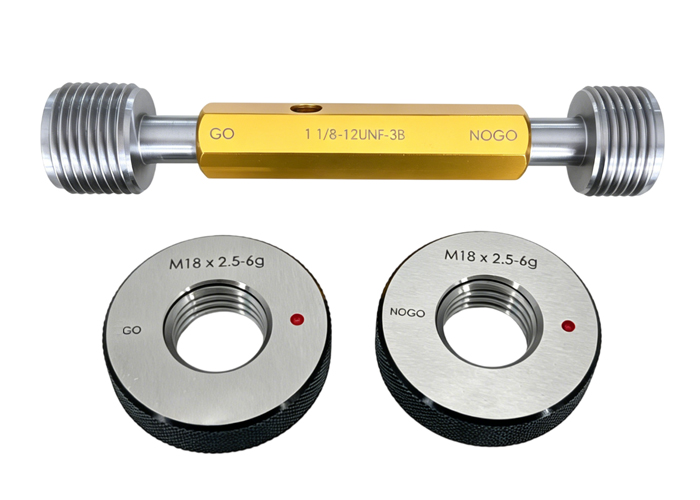
Welcome to the Mishute Technical Reference Center. We provide essential engineeringdata and calibration standards to ensure 100% Quality Assurance and eliminatedimensional measurement risks.
1. Thread Standards Quick Reference
Mishute precision gauges support major global thread systems engineered to strict
international compliances.
Unified Inch (UN/UNC/UNF/UNEF): Governed by ASME B1.1 (Threads) & ASME B1.2
(Gauges). Class 1A/2A/3A (External) and 1B/2B/3B (Internal).
ISO Metric (M/MJ): Governed by ISO 68-1 & ISO 1502. Commonly utilized in 6H (Plug)
and 6g (Ring) tolerances
Pipe & Special Threads: Includes G (BSPP) parallel pipe threads (55°angle), heavy-load ACME (29°angle), and power-transmission Trapezoidal (Tr) (30°angle).
2.SOP for Go/No-Go Gauge Inspection
Strictly adhere to this procedure to maintain data integrity and prevent premature gauge
wear:
[INSPECTION FLOW]
→Verify Calibration Label (Must be valid)
→Clean Parts & Gauges (Remove oil, chips, and burrs)
→Test GO Gauge → Must engage smoothly by hand → [FAIL if forced]
→Test NO-GO Gauge → Must NOT enter past 3 turns → [FAIL ifpasses]
(1)Thermal Equilibrium: Acclimatize gauges and workpieces in the same environment
(ideally 20°C / 68°F) for 4+ hours before checking.
(2)GO Gauge Rule: Hand-thread the GO gauge. It must pass through the full functional
length freely. Never force with tools.
(3)NO-GO Gauge Rule: Attempt to hand-thread the NO-GO gauge. It must not enter the
part. A maximum engagement of 3 turns is allowed under ASME/ISO standards; any
further engagement constitutes a fail.
3.Maintenance, Storage & Calibration
● Calibration Interval:Recalibrate every 6 to 12 months depending on usage frequency
and workpiece abrasiveness (e.g., aluminum vs.cast iron).
●Shift Care: Clean with a lint-free cloth and solvent. Apply acid-free instrument oil before
and after daily use.
●Storage: Store dry in original protective packaging. Maintain ambient relative humidity
below 50% to eliminate oxidation risks.
4.Advanced Material: Steel vs.Ceramic (ZrO2) Gauges
Mishute specializes in Yttria-stabilized Zirconia(ZrO2) ceramic gauges for high-wear or
cleanroom environments.
| Material Performance Comparison | |
| Vickers Hardness | Tool Steel Gauges (~700-800HV)|Mishute Ceramic (-1200-1400HV) -> Advantage: 10x wear resistance; maintains calibration limits longer. |
| Corrosion Resistance | Tool Steel Gauges (Vulnerable to rust) | Mishute Ceramic(100%Inert & Immune) -> Advantage: No oiling required; safe for fingerprint acids. |
| Impact Resiliency | Tool Steel Gauges (Deforms / Creates burrs)| Mishute Ceramic (NoDeformation) -> Advantage: Will not raise burrs; guarantees absolute dimensionalsafety. |
Precision Specifications & Tolerance Grades
| Ceramic Gauge Blocks (Slip Gauges) | ISO 3650 / ASME B89.1.9 |
| Grade K (Calibration) | Primary laboratory standards for instrument calibration. |
| Grade 0(Reference) | For high-precision toolrooms and checking electronic gauges. |
| Grade 1 (Working) | Optimized for shop-floor jig checks and CNC machining lines. |
| Plain Plug Gauges (Go / No-Go) | ISO 286 / ANSI B4.2 |
| Size Range | 1.000 mm to 50.000 mm (Custom fractional/inch profiles available). |
| Precision Class | Class XX & X (Aerospace precision) | ClassY& Z (Standard industrialproduction). |
| Geometry | Roundness and taper tolerances are held within 0.5 μm for Class Xparameters. |
? 5. Quick Technical FAQ
Q: Why does a GO gauge stick if CNC settings are correct?
A: This indicates geometric defects rather than pitch size errors. Check for thread
drunkenness (lead error), part taper, or entry burrs.
Q: What is the difference between ASME Class 2 and Class 3 fits?
A: Class 2A/2B provides standard clearances for general assembly. Class 3A/3B enforcesextremely tight tolerances with zero allowance, critical for high-vibration aerospace andautomotive powertrains
Q: Can I check a 6G specified thread with a 6H gauge?
A: No. A 6H gauge evaluates standard internal fits. A 6G thread requires a modifiedtolerance position. Using a 6H gauge will yield false rejections.