
The Direct Answer
Ceramic ring gauges should be used when corrosion resistance, non-magnetic inspection, clean handling, and long-term dimensional stability are more important than the lowest initial purchase cost. They are especially suitable for external diameter inspection in humid environments, clean inspection areas, non-magnetic applications, and precision quality control systems where steel gauge rust or magnetization may become a problem.
A ceramic ring gauge is not automatically the right choice for every shaft, pin, or rod inspection task. For general workshop use, steel ring gauges are often practical and cost-effective. For frequent high-wear production inspection, other high-wear materials may also be considered. But when rust, magnetic attraction, surface cleanliness, or controlled metrology conditions matter, ceramic becomes a strong option.
For B2B buyers, the practical question is not “Is ceramic better?” The better question is: does your inspection environment create problems that ceramic material can solve?
MISHUTE provides ring gauges for precision external diameter inspection, Go/No-Go checking, and custom dimensional control applications.
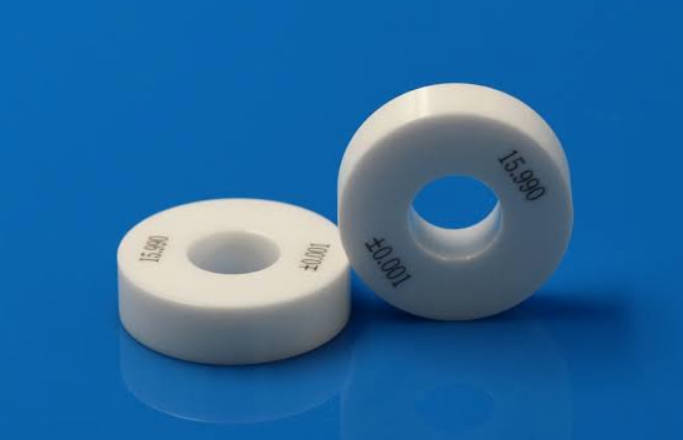
What Is a Ceramic Ring Gauge?
A ceramic ring gauge is a precision ring-shaped gauge made from advanced ceramic material. Its internal diameter is manufactured to a controlled size and tolerance, allowing it to check the outside diameter of cylindrical parts or serve as a reference ring in specific inspection systems.
Ceramic ring gauges may be used for:
- Shaft outside diameter inspection
- Pin and rod diameter checking
- Cylindrical part Go/No-Go inspection
- Clean-room dimensional inspection
- Corrosion-sensitive quality control
- Non-magnetic inspection applications
- Master or reference gauge use
- Precision production inspection
- Custom external diameter checking
A ceramic ring gauge performs the same basic dimensional function as a ring gauge, but its material properties make it more suitable for special inspection environments.
The important point is that ceramic changes the material behavior of the gauge. It does not remove the need for correct tolerance selection, calibration, careful handling, or a defined inspection procedure.
The Main Reason to Choose Ceramic: Environment
Many buyers first compare ring gauges by hardness, cost, or tolerance. Those factors matter, but ceramic ring gauges are usually selected because of the working environment.
Ceramic becomes more valuable when the inspection area includes one or more of these conditions:
| Inspection Condition | Why Ceramic May Help |
| Humidity | Reduces rust-related concerns compared with steel |
| Chemical exposure | Offers corrosion resistance in many applications |
| Clean inspection area | Helps reduce rust-prevention oil and contamination concerns |
| Non-magnetic requirement | Avoids magnetization and attraction of metal particles |
| Long storage interval | Reduces rust maintenance during storage |
| Precision inspection | Supports stable reference use when handled properly |
| Frequent handling by operators | Reduces some maintenance risks, though careful handling is still required |
Ceramic ring gauges are most useful when the inspection environment makes steel gauge maintenance difficult.
If the inspection room is dry, clean, well controlled, and cost-sensitive, steel may still be enough. If the ring gauge often faces moisture, fingerprints, coolant mist, cleaning chemicals, or magnetic contamination risk, ceramic deserves serious consideration.
When Ceramic Ring Gauges Make the Most Sense
1. Humid or Corrosion-Sensitive Inspection Areas
Steel gauges require rust prevention. In many real production environments, operators may handle gauges with bare hands, parts may carry moisture or coolant residue, and storage conditions may not be ideal. Over time, rust can affect gauge surfaces, fit, and inspection reliability.
Ceramic ring gauges are useful when:
- The factory environment is humid.
- Parts may carry moisture or coolant.
- Rust prevention is difficult to maintain.
- Gauges are stored for long periods.
- Surface cleanliness matters.
- Gauge maintenance resources are limited.
A corrosion resistant ring gauge can reduce one major risk: the gauge surface changing because of rust. This does not mean ceramic gauges require no care, but it can make long-term gauge control easier in difficult environments.
2. Non-Magnetic Inspection Requirements
Some inspection tasks are sensitive to magnetism. A steel gauge can become magnetized through contact, storage conditions, nearby magnetic tools, or handling in certain workshop environments. A magnetized gauge may attract fine metal particles, which can interfere with clean inspection.
Ceramic ring gauges are non-magnetic, making them suitable for:
- Electronic component inspection
- Optical component inspection
- Precision assembly environments
- Small ferrous parts where metal dust may stick to tools
- Inspection areas that require non-magnetic measuring tools
- Applications where magnetic attraction may disturb the part or measurement
Use ceramic ring gauges when magnetic attraction, metal particle contamination, or non-magnetic tooling requirements are part of the inspection risk.
This is one of the clearest reasons to choose ceramic over steel.
3. Clean Inspection and Reduced Oil Contamination
Steel gauges often need rust-prevention oil or controlled storage conditions. In some inspection environments, that is not ideal. Oil residue can contaminate clean parts, optical components, medical-related components, or precision assemblies.
Ceramic ring gauges can be useful when:
- Parts must remain clean after inspection.
- Rust-prevention oil should be minimized.
- Inspection takes place in a controlled clean area.
- Operators need gauges that are easier to wipe clean.
- The inspected parts are sensitive to contamination.
For clean inspection, ceramic material helps reduce the need for anti-rust treatment. However, ceramic gauges should still be cleaned, protected from dust, and stored correctly.
4. Precision Reference and Master Gauge Applications
Ceramic ring gauges may be considered when the gauge will be used as a reference ring or master ring under controlled conditions.
In this role, the gauge may be used to:
- Verify measuring equipment
- Support comparative measurement
- Serve as a controlled reference size
- Check external cylindrical features
- Support internal quality systems
For master or reference use, the key requirements are not only material. The buyer should also confirm tolerance grade, actual measured value, certificate, traceability, handling rules, and storage conditions.
A ceramic master ring gauge may be suitable when the inspection system benefits from corrosion resistance, non-magnetic properties, and clean storage.
5. Long-Term Storage or Intermittent Use
Some gauges are not used every day. They may stay in storage for weeks or months before being needed again. Steel gauges stored in poor conditions may require careful rust prevention. If that maintenance is not consistent, the gauge can degrade.
Ceramic ring gauges may be useful when:
- The gauge is used intermittently.
- Storage conditions are not perfectly controlled.
- Anti-rust maintenance is difficult.
- The gauge is part of a backup inspection system.
- Operators want lower rust-related storage risk.
Ceramic does not mean “no maintenance,” but it can reduce the specific maintenance burden related to rust.
When Ceramic Ring Gauges May Not Be Necessary
Ceramic is useful, but not always necessary. A good purchasing decision should also define when ceramic is not required.
| Situation | Why Ceramic May Not Be Needed |
| General workshop inspection | Steel ring gauges may be more cost-effective |
| Low inspection frequency | The cost difference may not be justified |
| Dry and controlled storage | Rust risk may already be well managed |
| High impact risk | Ceramic needs careful handling and impact protection |
| Very budget-sensitive projects | Steel may provide better value |
| Extremely high-wear repeated use | Other wear-focused material options may need comparison |
| Simple rough checking | Precision ceramic may exceed actual inspection needs |
Ceramic ring gauges should be chosen for a specific inspection reason, not simply because ceramic sounds more advanced.
If the application is ordinary shaft inspection in a dry QC room, steel may be suitable. If the application requires corrosion resistance, non-magnetic behavior, or cleaner handling, ceramic becomes more relevant.
Ceramic Ring Gauges vs Steel Ring Gauges
The most common comparison is ceramic vs steel.
| Factor | Ceramic Ring Gauges | Steel Ring Gauges |
| Corrosion resistance | Strong advantage in many environments | Requires rust prevention |
| Magnetic behavior | Non-magnetic | May be affected by magnetization |
| Clean handling | Reduces need for anti-rust oil | May require oil or controlled storage |
| Cost | Usually higher | Usually more economical |
| General workshop use | Suitable when environment requires it | Common and practical |
| Impact resistance | Requires careful handling | Often more forgiving under rough handling |
| Availability | May require confirmation for size and tolerance | Usually widely available |
| Long-term storage | Lower rust-related risk | Requires maintenance control |
| Best use case | Clean, humid, non-magnetic, corrosion-sensitive inspection | General OD inspection and cost-sensitive QC |
The choice depends on inspection risk. Steel is often practical for general-purpose ring gauges. Ceramic is better when the material solves a real problem in the inspection environment.
Ceramic Ring Gauges vs Other High-Wear Gauge Materials
Some buyers consider ceramic because they want longer gauge life. Ceramic can provide good wear performance in many precision inspection applications, but wear resistance is not the only factor.
For high-volume production inspection, buyers should evaluate:
- Contact frequency
- Part material
- Surface finish of the part
- Operator handling
- Cleaning process
- Abrasive contamination
- Gauge material
- Certificate and recalibration plan
If the gauge is used many times per shift on hard or abrasive parts, material selection should be discussed carefully. Ceramic may be suitable in some cases, while other high-wear gauge materials may be considered depending on the exact application.
The point is simple: ceramic is a strong option for corrosion, clean, and non-magnetic environments. For extreme wear-only applications, the full inspection condition should be reviewed before final material selection.
How Ceramic Ring Gauges Work in OD Inspection
For external diameter inspection, the part is checked against the internal diameter of the ring gauge. The gauge may be used as a single plain ring or as part of a Go/No-Go system.
For a cylindrical shaft:
- The GO ring checks whether the shaft is not too large.
- The NO-GO ring checks whether the shaft is not too small.
- The inspection result depends on whether the part passes the defined ring condition.
| Ring Gauge Type | Function in OD Inspection | Expected Result |
| Plain ceramic ring gauge | Checks one defined outside diameter condition | Fit depends on inspection rule |
| GO ceramic ring gauge | Checks maximum OD limit | Should pass over the part |
| NO-GO ceramic ring gauge | Checks minimum OD limit | Should not pass over the part |
| Ceramic master ring gauge | Serves as reference or setting gauge | Used under controlled conditions |
| Custom ceramic ring gauge | Matches special drawing requirements | Used for dedicated inspection |
For reliable OD inspection, the ceramic material alone is not enough. The gauge size, tolerance, certificate, marking, and inspection method must match the part drawing.
What to Specify When Ordering Ceramic Ring Gauges
A complete inquiry should include more than “ceramic ring gauge + size.”
Prepare the following:
| Required Information | Why It Matters |
| Nominal outside diameter | Starting point for gauge sizing |
| Upper and lower part tolerance | Determines GO/NO-GO limits |
| Metric or inch unit | Avoids unit conversion mistakes |
| Plain, GO, NO-GO, or master use | Defines gauge function |
| Ceramic material requirement | Confirms material selection |
| Gauge tolerance or grade | Controls inspection reliability |
| Certificate requirement | Supports quality systems and audits |
| Quantity | Affects production and quotation |
| Marking requirement | Helps operators identify gauge function |
| Working or master use | Affects handling and tolerance needs |
| Part material | Helps evaluate wear and contact behavior |
| Inspection frequency | Helps decide whether ceramic is suitable |
| Drawing | Reduces specification mistakes |
If the gauge is used for production acceptance, provide the part drawing and tolerance limits. If it is used as a master or setting reference, provide the required reference size and certificate expectations.
For drawing-based OD inspection, custom ring gauges should be specified with clear tolerance and usage information.
Common Mistakes When Buying Ceramic Ring Gauges
Mistake 1: Choosing Ceramic Without Defining the Inspection Problem
Ceramic should solve a real problem: corrosion, magnetism, clean handling, storage risk, or controlled reference use. If none of these problems exist, steel may be more practical.
Mistake 2: Ordering by Nominal Size Only
A ceramic ring gauge still needs correct tolerance. Nominal diameter alone is not enough for precision OD inspection.
Mistake 3: Ignoring GO and NO-GO Logic
If the gauge is used for shaft acceptance, buyers must define whether they need a GO ring, NO-GO ring, or both.
Mistake 4: Treating Ceramic as Damage-Proof
Ceramic is hard and corrosion resistant, but it should not be dropped, hit, or used carelessly. Impact damage can affect precision surfaces.
Mistake 5: Forgetting Calibration
Ceramic gauges still need calibration or verification. Material selection does not replace gauge control.
Mistake 6: Using a Master Gauge as a Working Gauge
A ceramic master ring gauge should be protected. Daily production use may increase handling risk and make traceability harder to control.
Ceramic Ring Gauge Selection Matrix
Use this matrix to decide whether ceramic is the right material.
| Question | If Yes | If No |
| Is the inspection area humid? | Ceramic may be useful | Steel may be enough |
| Is corrosion a recurring issue? | Ceramic is a strong option | Compare cost and tolerance first |
| Is non-magnetic inspection required? | Ceramic is suitable | Steel may be acceptable |
| Are clean parts being inspected? | Ceramic may reduce oil-related concerns | Steel can still work with good cleaning |
| Is the gauge used as a master reference? | Consider ceramic with certificate | Working gauge may be enough |
| Is purchase cost the main concern? | Ceramic may not be necessary | Steel may be better value |
| Is impact risk high? | Extra handling control is needed | Steel may be more forgiving |
| Is the gauge used very frequently? | Review wear and material needs | Standard material may be enough |
This type of decision matrix is useful because it prevents material selection from becoming a vague preference. It turns the choice into an engineering decision.
How to Evaluate a Ceramic Ring Gauge Supplier
A suitable supplier should help confirm both dimensional requirements and material suitability.
Look for support in:
- Plain, GO, NO-GO, and master ring gauge selection
- Ceramic material recommendation
- Custom size and tolerance discussion
- Drawing review
- Certificate support
- Clear gauge marking
- Protective packaging
- Working vs master gauge guidance
- Quality control documentation
A ceramic ring gauge is often a more application-specific purchase than a standard working gauge. The supplier should understand why ceramic is being selected and whether it matches the inspection task.
For shaft, pin, rod, and cylindrical part inspection, precision ring gauges should be specified with the correct tolerance, material, certificate, and usage role.
FAQ
What are ceramic ring gauges used for?
Ceramic ring gauges are used for external diameter inspection, Go/No-Go checking, master reference applications, and precision quality control where corrosion resistance, non-magnetic behavior, or clean handling is important.
When should I use ceramic ring gauges instead of steel ring gauges?
Use ceramic ring gauges when rust, humidity, magnetic attraction, oil contamination, or clean inspection requirements make steel gauges less suitable. Steel gauges may still be better for general cost-effective inspection.
Are ceramic ring gauges corrosion resistant?
Yes. Ceramic ring gauges are commonly selected for corrosion-resistant inspection because they do not rust like steel. They are useful in humid or corrosion-sensitive environments.
Are ceramic ring gauges non-magnetic?
Yes. Ceramic ring gauges are non-magnetic, making them suitable for inspection environments where magnetic attraction or metal particle contamination may affect the measurement process.
Can ceramic ring gauges be used for shaft inspection?
Yes. Ceramic ring gauges can be used for shaft, pin, rod, and cylindrical outside diameter inspection when the gauge is made to the correct size, tolerance, and inspection function.
Are ceramic ring gauges better than steel?
Ceramic ring gauges are better for corrosion resistance, non-magnetic inspection, and clean handling. Steel ring gauges are often better for general workshop use and cost-sensitive applications.
Do ceramic ring gauges need calibration?
Yes. Ceramic ring gauges still need calibration or verification according to inspection frequency, tolerance requirements, quality system rules, and customer audit needs.
When should I order custom ceramic ring gauges?
Order custom ceramic ring gauges when you need special size, tight tolerance, GO/NO-GO function, master reference use, special marking, or certificate requirements based on a specific drawing.
Conclusion
Ceramic ring gauges are most valuable when the inspection environment creates risks that steel gauges may not handle well. If corrosion resistance, non-magnetic behavior, cleaner handling, and stable long-term storage are important, ceramic is a strong material choice.
However, ceramic is not automatically necessary for every OD inspection task. Steel ring gauges may still be practical for general workshop inspection and cost-sensitive quality control. The right decision depends on the part tolerance, inspection environment, usage frequency, material contact, certificate requirement, and whether the gauge is used as a master or working gauge.
For shaft, pin, rod, and cylindrical component inspection, MISHUTE provides ceramic ring gauges and related precision gauge options for application-specific dimensional control.
3. Internal Linking Plan
| Anchor Text | Target URL | Suggested Placement | Reason |
| ring gauges | https://mishute.com/ring-gauges/ | Opening section | Core product keyword directly supports the article topic |
| custom ring gauges | https://mishute.com/ring-gauges/ | Ordering specification section | Matches drawing-based ceramic ring gauge purchase intent |
| precision ring gauges | https://mishute.com/ring-gauges/ | Supplier evaluation section | Supports commercial selection after technical comparison |
| ceramic ring gauges | https://mishute.com/ring-gauges/ | Conclusion | Directly matches the primary product keyword and conversion intent |